
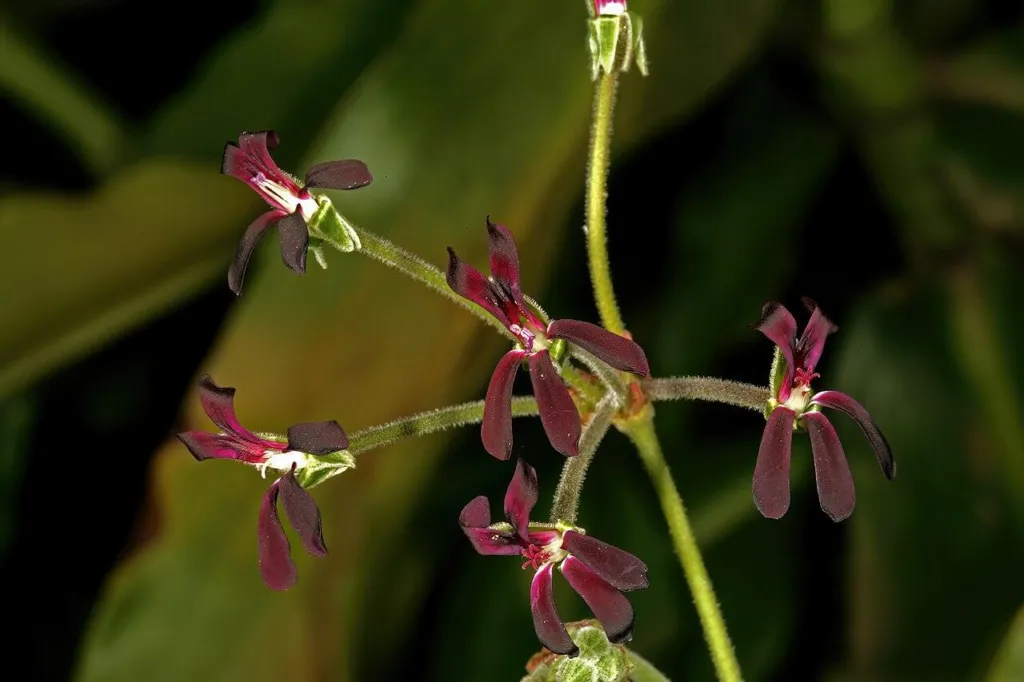
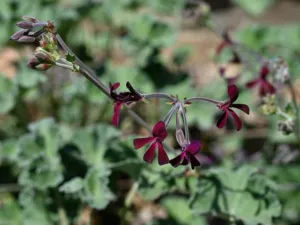
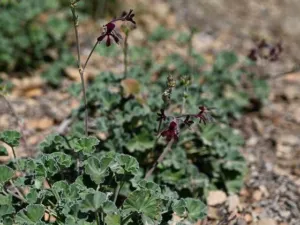
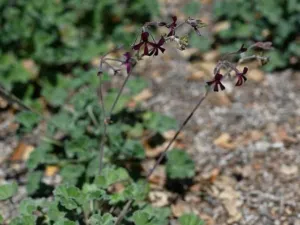
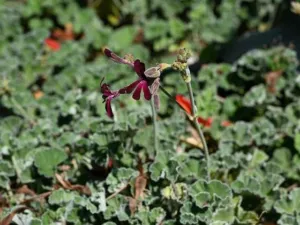
Cover: Pelargonium sidoides in flower. Photo: SAplants · CC BY-SA 4.0 · Wikimedia Commons
Australians buy this plant without knowing its name. The dark liquid in the small brown bottle on the cough-and-cold shelf is a root extract of Pelargonium sidoides, a low, black-flowered geranium relative from the grasslands of the Eastern Cape and Lesotho, and it is one of the few herbal medicines in this country to hold a full registration, where almost every other herbal medicine here is merely listed — safety, quality and efficacy all assessed before sale (ARTG 193170). Confirmed
It also carries a Cochrane review that grades its own evidence as low quality, a liver warning that no individual case has survived independent causality assessment, a 2026 independent trial that found nothing, and a patent fight that a community near Alice in the Eastern Cape took to Munich and won. This is No. 4 in the Australian Institute of Pharmacognosy’s evidence-graded monograph series: what the plant is, where it comes from, whose it was first, what the trials actually found, what the safety record actually says, and what an Australian buyer can check on a label.
This article is educational. It is not medical, legal or regulatory advice, it is not an advertisement, and nothing in it is a recommendation to buy, prepare or take pelargonium or any named product.
1. Get the illness right before the herb. A chesty cough with breathlessness, chest pain, coughed-up blood, a high or persistent fever, confusion, one that has run past three weeks, or one in an infant, a frail or an immunosuppressed person, needs assessment and not a cough bottle. The European monograph’s own rule is that if symptoms persist beyond a week of use, or worsen at any point during it, the product is stopped and the person reviewed (EU herbal monograph, rev. 2). Confirmed Symptomatic relief in the first week is exactly how a serious chest illness gets missed (§9).
2. Allergic reactions are on the record. Hypersensitivity, including anaphylactic reaction, rash, urticaria and angioedema, is listed in the current European monograph with the frequency recorded as not known (EU herbal monograph, rev. 2). Confirmed Anyone who has reacted to a pelargonium product before should avoid all of them.
3. Liver warnings exist and are worth reading properly. Hepatotoxicity and hepatitis have been reported and are in the monograph, frequency not known; the monograph says to stop the product immediately if signs of liver injury appear (EU herbal monograph, rev. 2). Confirmed Those signs, since a label rarely lists them: yellowing of the skin or the whites of the eyes, dark urine, pale stools, persistent itch, pain under the right ribs, or unexplained nausea, loss of appetite and marked fatigue. No individual reported case has reached probable causality on independent, liver-specific causality assessment (§9). Both of those statements are true.
4. Who the monograph says should not use it. Oral use is not recommended in children under three years, and use in pregnancy and breastfeeding is not recommended because safety has not been established (EU herbal monograph, rev. 2). Confirmed Before taking any botanical drug, consult a degree-qualified herbalist with competencies and adequate training in pharmacognosy.
5. Legal status in Australia. Pelargonium sidoides is not in the Poisons Standard and is not a controlled substance. Two registered (AUST R) products may be supplied here; two further ARTG entries are export-only and must not be sold in Australia (§10).
Emergency: for difficult or noisy breathing, throat or tongue swelling, wheeze, a hoarse voice, dizziness or collapse, call Triple Zero (000) immediately. For a swallowed overdose, an accidental dose in a child, or any poisons advice, call the Poisons Information Centre on 13 11 26 (24 hours, Australia-wide).
| Botanical name | Pelargonium sidoides DC., Geraniaceae Confirmed §1 |
| Common names | Umckaloabo, African geranium, South African geranium, Cape pelargonium, rabassam, kalwerbossie Traditional §1 |
| Part used | The tuberous rootstock (dried underground organs) Confirmed §2 |
| Home range | Eastern Cape, Lesotho, Free State and southern Gauteng; short grassland, sea level to about 2,300 m Confirmed §3 |
| Traditional use | Coughs and chest complaints including tuberculosis; diarrhoea and dysentery Traditional §4 |
| Key constituents | Highly oxygenated simple coumarins (umckalin, scopoletin, fraxetin), oligomeric proanthocyanidins, gallic acid Confirmed §6 |
| Best evidence | Symptom relief in acute bronchitis, liquid extract, graded low quality by Cochrane; a 2026 independent pragmatic trial found no significant benefit Evidence suggests §8 |
| Does it treat the infection? | No trial has shown that it clears a pathogen Confirmed §7 |
| When not to self-treat | Breathlessness, chest pain, coughed-up blood, high fever, a cough past three weeks, or a cough in an infant or a frail or immunosuppressed person — assessment, not a cough bottle Confirmed §9 |
| Children | Oral use not recommended under 3 years; liquid forms only under 6; the Australian liquid’s closure is not child-resistant Confirmed §9 |
| Main safety questions | Hypersensitivity including anaphylaxis; reported hepatotoxicity, never reaching probable causality on independent case-by-case assessment; mucosal bleeding Confirmed §9 |
| Australian status | Two registered (AUST R) products; not in the Poisons Standard; no occurrence records in the Atlas of Living Australia Confirmed §10 |
| Pregnancy and breastfeeding | Not recommended — safety not established, no fertility data Confirmed §9 |
| Supply ethics | The medicine is a tuber, so harvest kills the plant; cultivated or permitted material is the honest ask Evidence suggests §11 |
- Confirmed Established in humans by trial, or an unambiguous analytical, chemical or official-record fact — for example, what a regulator’s own published document says.
- Evidence suggests Real published data, but preclinical, observational, small or not yet independently replicated.
- Mechanism A plausible mechanistic or pharmacological inference, not an outcome.
- Traditional Historical or ethnobotanical use. Evidence of practice, not of efficacy.
- Attested A documentary fact attested in a named record — a patent register, a committee’s published minutes, a historical account. A textual reading, not a claim about what a plant does.
Every PubMed ID (PMID) links to its record and was checked against PubMed on 20/09/2026. Every compound was checked against PubChem and is linked by CID. Every Australian regulatory statement was read from the regulator’s own document on the same day. Where a claim could not be traced to a primary source it is marked unsourced and stays that way.
What it is. A low, black-flowered relative of the garden geranium from the grasslands of the Eastern Cape and Lesotho. The medicine is the tuberous root, used in southern Africa for coughs, chest complaints and dysentery long before Europe knew what the plant was. Traditional Europe bought the root as a secret remedy from 1897 and only identified the species in 1977. Attested
Does it work? A specific liquid root extract shortens and softens the symptoms of acute bronchitis in adults and children across several trials — and the Cochrane review that pooled them graded that evidence low quality, with publication bias suspected and every trial investigator-initiated. Evidence suggests Tablets did not perform as the liquid did. In April 2026 an independent Swiss pragmatic trial of 332 adults found no significant benefit over usual care. Confirmed Nothing shows it treats the infection itself.
Is it safe? The first safety question is not the herb but the cough: breathlessness, chest pain, coughed-up blood, high fever, a cough past three weeks, or a cough in an infant or someone frail or immunosuppressed is an assessment, not a purchase, and the monograph itself says to stop at a week if symptoms have not gone. Confirmed The herb itself is mostly unremarkable: mild gut upset is the common complaint. Allergic reactions including anaphylaxis are reported at unknown frequency. Liver injury has been reported and warned about — yet when 28 spontaneous cases were scored on the standard liver causality scale, not one reached probable causality. Confirmed The coumarins in this root are structurally incapable of warfarin-like anticoagulation, though nosebleeds and gum bleeding sit on the adverse-effect list. Confirmed
What is unusual about Australia. Both products sold here are registered (AUST R), so efficacy was assessed before sale. The TGA’s own advisory committee recommended registration in 2011 while some of its members called the quality-control method “20 years out of date”, one raised possible substitution with the sibling species P. reniforme, and the committee said the approval should be reviewed if the evidence changed. Attested The evidence has since changed.
The thing nobody prints on the box. The extract was patented in Europe; a community near Alice in the Eastern Cape, with the African Centre for Biosafety, opposed the patent and it was revoked in 2010 — on ordinary patent grounds, not on the traditional-knowledge argument. Attested Harvesting the tuber kills the plant, so cultivated or permit-backed root is the honest ask. Before taking any botanical drug, consult a degree-qualified herbalist with competencies and adequate training in pharmacognosy.
1. The name on the box, and the name of the plant
Walk into an Australian pharmacy in August and you will find a small brown-glass bottle of dark liquid sold for a chesty cough. The front says Kaloba. The back says Pelargonium sidoides root extract. Almost nobody who buys it could tell you that the plant is a geranium relative from the grasslands of the Eastern Cape and Lesotho, that it was taken to Europe by a British man trying to cure his own tuberculosis, or that the extract inside was the subject of a patent fight that a South African community took to Munich and won.
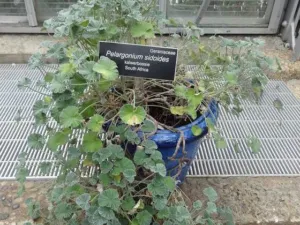
Pelargonium sidoides DC., family Geraniaceae, is the accepted botanical name. Confirmed The genus name comes from the Greek pelargos, a stork, for the long beaked fruit; the epithet sidoides records a resemblance of the foliage to the European plant Sida rhombifolia (SANBI PlantZAfrica). Attested The English trade name most often used for the root and the extract is umckaloabo, and in Australia you will also see African geranium, South African geranium, Cape pelargonium, rabassam and kalwerbossie. Traditional
“Umckaloabo” is not a botanical word at all. It is an anglicised southern African name carried back to Britain with the remedy, and the reviewers who have gone through the old sources read it as a compound of Zulu terms for a feverish cough and for chest pain (PMID 18725280). Attested The name travelled better than the plant’s identity did: for most of the twentieth century Europe bought the root without knowing which species it came from.
The sibling that keeps turning up
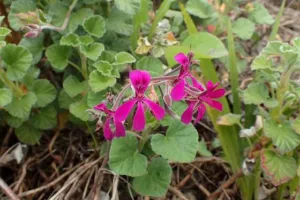
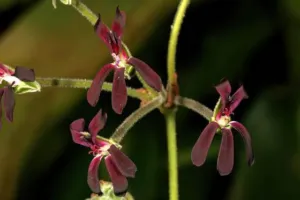
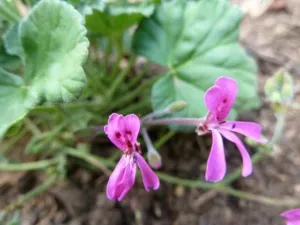
The one name an Australian buyer should also know is Pelargonium reniforme Curt. It is a close relative, it grows in the same region, its root contains a similar spread of coumarins, and it has been used in the same way. The European Pharmacopoeia monograph for pelargonium root (Pelargonii radix, monograph 2264) accepts the dried underground organs of either species (EMA assessment report). Confirmed The two are separated most easily in flower: P. sidoides has near-black, deep maroon petals; P. reniforme has pink to magenta ones (SANBI PlantZAfrica). Confirmed That distinction matters for anyone buying dried root, where the flowers are long gone — and it is exactly the point Australia’s own regulatory committee raised in 2011, as we will get to in §10.
2. What the plant is actually like
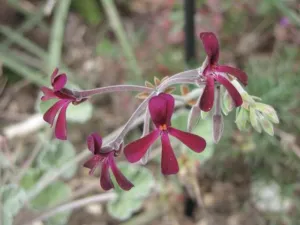
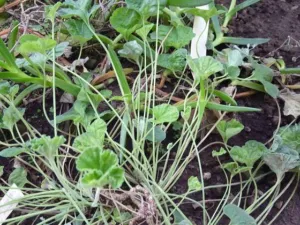
Pelargonium sidoides is not the showy pelargonium of a Queensland verandah. It is a low, rosette-forming perennial, close to the ground, with long-stalked, heart-shaped, velvety leaves that are mildly aromatic when bruised and a grey-green that reads as silver in strong light. The flowers are held on slender stalks well above the foliage and are a dark reddish-purple so deep it photographs as black. In its home range it flowers over much of the year with a midsummer peak in December (SANBI PlantZAfrica). Confirmed
The part that matters medicinally is underground, and it explains almost everything about the supply problem in §11. Below the rosette sits a system of thickened, root-like branches — the tuberous rootstock — that lets the plant survive both the annual grass fires across its range and the dry winter, sprouting again when the summer rain arrives (SANBI PlantZAfrica). Confirmed It is a fire-and-drought survival organ that happens to be the pharmacologically interesting tissue. You cannot take it without killing the plant.
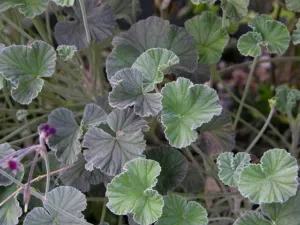
The Pelargonium genus runs to well over two hundred species, most of them southern African, and about four fifths of the South African species are confined to the winter-rainfall south-west (SANBI PlantZAfrica). Confirmed P. sidoides is one of the summer-rainfall outliers, which is why it grows in grassland, where most of the genus sits in fynbos.
3. Where it grows — and what it is doing in Australia
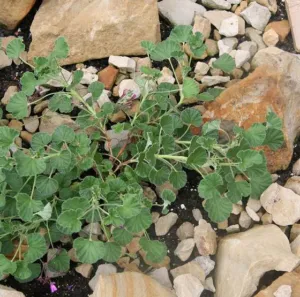
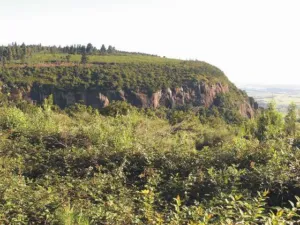
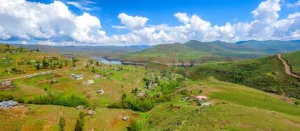
The species is widespread but regional. It occurs through the Eastern Cape, Lesotho, the Free State and the southern and south-western parts of Gauteng, in short grassland and sometimes among scattered shrubs, on stony soils from sand to clay-loam, shale or basalt. It grows from near sea level to about 2,300 m in Lesotho, in country that takes its rain in summer — between 200 and 800 mm a year (SANBI PlantZAfrica). Confirmed The South African Red List assessment is Least Concern (SANBI PlantZAfrica), and the species was assessed for the global IUCN Red List in 2022 (IUCN Red List assessment, 2022). Confirmed Least Concern at the species level is not the same thing as “the stands you are buying from are fine”, a distinction §11 takes seriously.
The Australian position, checked
We searched the Atlas of Living Australia for Pelargonium sidoides on 20/09/2026. It returned no occurrence records (Atlas of Living Australia). Confirmed There is no evidence in the national biodiversity record that the species has naturalised anywhere in Australia. It is not on Queensland’s prohibited or restricted invasive plant lists under the Biosecurity Act 2014 (Queensland invasive plant lists), Confirmed though every landholder in Queensland still carries a general biosecurity obligation for any plant they grow.
What Australia does have is its own pelargoniums. The Atlas holds 7,915 records of the native Pelargonium australe, along with 235 of P. drummondii and 151 of P. havlasae, and 1,322 records of the naturalised South African P. capitatum (Atlas of Living Australia). Confirmed So the genus is not foreign here at all — only this species is. If you buy a live P. sidoides plant from an Australian specialist nursery, you are buying a garden subject that has not shown up in the wild; if you import seed or plant material yourself, that is a biosecurity matter and the conditions are set by the Commonwealth import system, not by the seller (BICON import conditions).
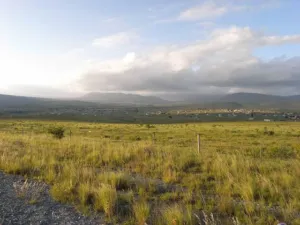
In Cardwell, where this Institute sits, the climate argument against it is straightforward: a plant adapted to a dry winter, frost, annual grass fire and 200–800 mm of summer rain has no obvious future in a wet-tropics garden that can take that much rain in a fortnight. It is a plant for a dry, well-drained, cold-winter garden — Toowoomba or Armidale; the Cassowary Coast would kill it.
4. Whose medicine this was first, and how it got on a plane
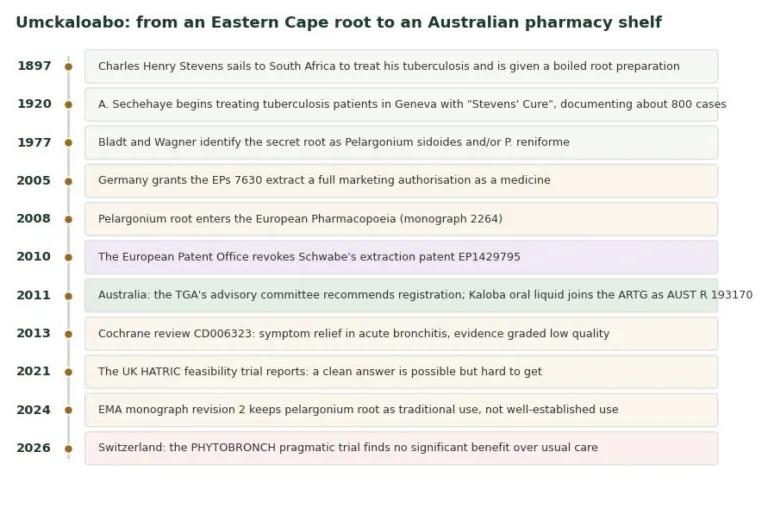
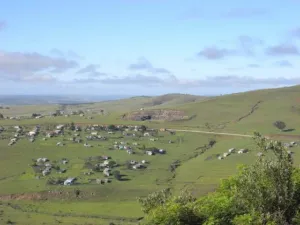
Tuberous Pelargonium species are long-standing medicines in southern Africa. Infusions and decoctions of the roots of P. sidoides and P. reniforme were used for coughs and chest complaints including tuberculosis, and for gastrointestinal illness including diarrhoea and dysentery; the aerial parts were used on wounds (EMA assessment report, PMID 18725280). Traditional Brendler and van Wyk, reviewing the ethnobotany and the commercial history together, make the point that the use of pelargonium stems and tubers across southern African practice has been consistently underestimated in the European literature (PMID 18725280). Traditional That is evidence of practice. It is not, on its own, evidence that the root cures anything.
The European chapter starts with a specific man on a specific voyage. Charles Henry Stevens, a British mechanic with tuberculosis, sailed to South Africa in 1897 on medical advice, in search of dry mountain air. He was treated by a local healer with a boiled root preparation, believed himself cured three months later, went home and set up a company to sell it as “Stevens’ Consumption Cure” (EMA assessment report, PMID 18725280). Attested He never said what the plant was. In 1920 a French-Swiss physician, A. Sechehaye, began treating tuberculosis patients in Geneva with Stevens’ preparation and documented roughly eight hundred cases over nine years, reporting them to the Medical Society of Geneva (EMA assessment report). Attested Those are case reports from the 1920s, with everything that implies; they are part of the record and not part of the evidence base.
The identity of the root stayed a trade secret until 1977, when Bladt and Wagner at Munich used ethnobotanical, comparative botanical and chromatographic work to show that Stevens’ material came from Pelargonium sidoides and/or P. reniforme (EMA assessment report). Attested Eighty years after the voyage, the plant finally had a name in Europe, and the modern pharmacology began.

5. Who the plant belongs to
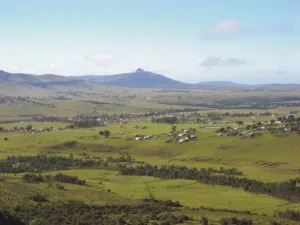
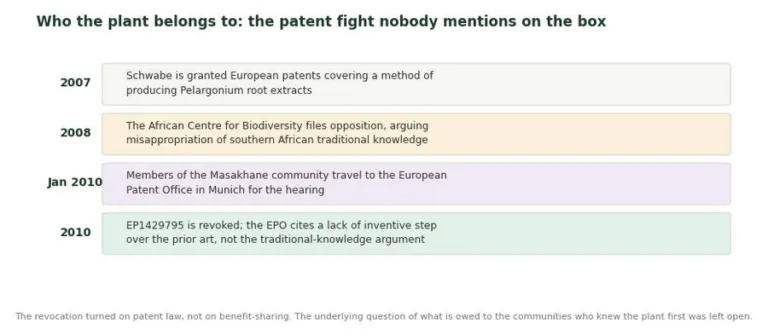
This is the part of the label that does not exist. In 2007 the German manufacturer Dr Willmar Schwabe GmbH & Co. KG held a granted European patent, EP1429795B1, over a method of producing extracts of Pelargonium sidoides and/or P. reniforme. The public patent record shows four oppositions filed in March 2008, and the patent’s legal status today is Revoked (EP1429795B1 patent record). Attested
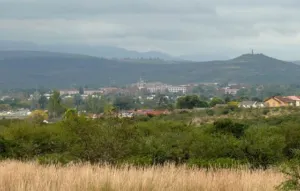
Three of the four opponents named on the register are themselves companies in the botanical extract trade — Frutarom Schweiz AG, Alpinamed AG and Finzelberg GmbH & Co. KG. Filing an opposition is an ordinary and entirely lawful step in European patent practice, and the register does not record anyone’s motive for doing it. The fourth opponent was of a different kind. The African Centre for Biosafety (now the African Centre for Biodiversity), working with the Masakhane community near Alice in the Eastern Cape and with European partners, argued that patents of this kind appropriated southern African traditional knowledge and that the benefit-sharing arrangements on the ground were inadequate. Community members travelled to the European Patent Office in Munich for the hearing in January 2010; the register records the revocation as taking effect on 26/01/2010. Two peer-reviewed accounts of the case exist and are worth reading in full: Msomi and Matthews on what intellectual property law could and could not do for Masakhane (Msomi & Matthews 2016), and van Niekerk and Wynberg on the trade itself and who actually captured its value (van Niekerk & Wynberg 2012). Attested
The outcome is instructive and slightly deflating. On both of those accounts the patent fell on ordinary patent grounds — a lack of inventive step over the prior art — and never on the traditional-knowledge argument, and Schwabe subsequently dropped the remaining pelargonium patents (Msomi & Matthews 2016, van Niekerk & Wynberg 2012). Attested The communities won the case and did not win the argument. The underlying question — what is owed to the people who knew the plant first, and who decides — was left where it was.
Why should an Australian buyer care? Because this is the live version of a set of obligations Australia has signed up to. The Nagoya Protocol on access and benefit-sharing sits under the Convention on Biological Diversity; South Africa regulates bioprospecting and benefit-sharing under its own national biodiversity legislation. A product built on a southern African medicinal plant has a provenance question attached to it that a price tag does not answer. Asking a supplier where the root came from, and under what permit, is not sentimentality — it is the only pressure a consumer market can actually apply.
6. What is in the root
The European Pharmacopoeia defines pelargonium root as the dried, usually fragmented underground organs of P. sidoides or P. reniforme, and sets a content specification of not less than 2.0% tannins, expressed as pyrogallol, on the dried drug (EMA assessment report). Confirmed Note what that standard is: a tannin assay, not a marker-compound assay. We will come back to that.
Three chemical families carry the interest.
Highly oxygenated simple coumarins. These are the genus signature and the compounds most often named on a certificate of analysis — umckalin (PubChem CID 5316862), scopoletin (PubChem CID 5280460), fraxetin (PubChem CID 5273569) and its sulfate and glucoside, 6,8-dihydroxy-5,7-dimethoxycoumarin and related patterns of combined oxygenation typical of Pelargonium (EMA assessment report). Confirmed They are present in modest amounts, and their combination is what makes the extract chemically recognisable.
Proanthocyanidins. By mass these dominate. Oligomeric and polymeric proanthocyanidins built on catechin (PubChem CID 9064) and gallocatechin (PubChem CID 65084) extender units occur at high concentration in the root (EMA assessment report). Confirmed They are also the reason the liquid is astringent and the reason the commonest adverse effect is a mildly upset stomach.
Simple phenolics. Gallic acid (PubChem CID 370) and its methyl ester (PubChem CID 7428) are present in appreciable yield and have been the most consistently active compounds in the antimycobacterial work (EMA assessment report). Confirmed
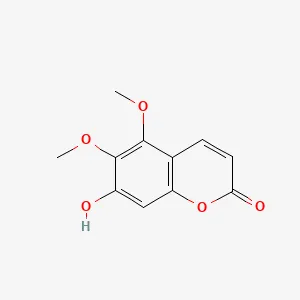
C11H10O5 · 7-hydroxy-5,6-dimethoxycoumarin, the genus marker
Depiction: PubChem CID 5316862 · public domain
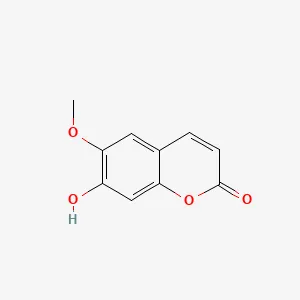
C10H8O4 · 7-hydroxy-6-methoxycoumarin
Depiction: PubChem CID 5280460 · public domain
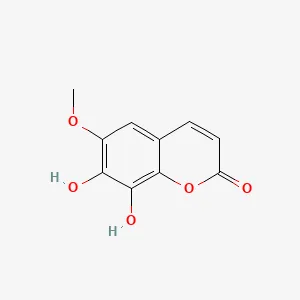
C10H8O5 · also present as the sulfate and glucoside
Depiction: PubChem CID 5273569 · public domain
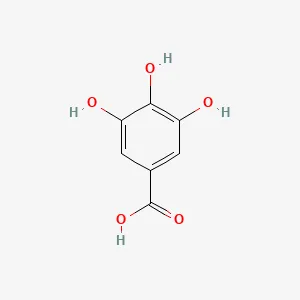
C7H6O5 · abundant, and active against mycobacteria in vitro
Depiction: PubChem CID 370 · public domain
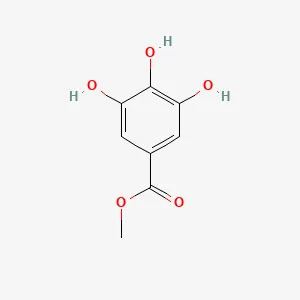
C8H8O5 · the methyl ester, similarly active
Depiction: PubChem CID 7428 · public domain
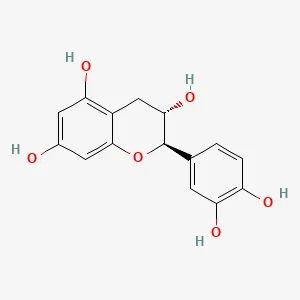
C15H14O6 · a proanthocyanidin extender unit
Depiction: PubChem CID 9064 · public domain
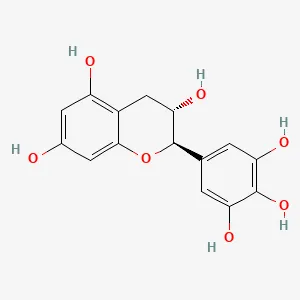
C15H14O7 · the other dominant extender unit
Depiction: PubChem CID 65084 · public domain
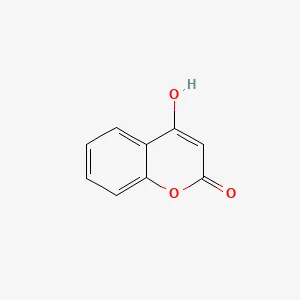
C9H6O3 · the anticoagulant scaffold — absent from this root
Depiction: PubChem CID 54682930 · public domain
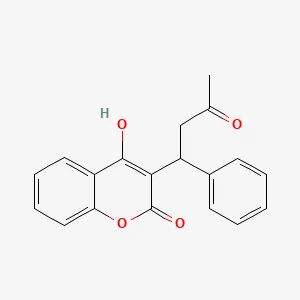
C19H16O4 · 4-hydroxy and 3-substituted: what pelargonium coumarins are not
Depiction: PubChem CID 54678486 · public domain
The last two are shown for contrast, not because they are in the plant: they are the shape a coumarin has to be to thin blood.
An LC-MS analysis of an aqueous root extract found glucogallin, fraxetin-7-O-glucoside, catechin, a dihydroxycoumarin sulfate, fraxetin sulfate, mono- and dihydroxy-dimethoxycoumarins, dihydrokaempferol and umckalin as the major constituents (EMA assessment report). Confirmed An HPLC method separating several of these has been published and validated (PMID 36297296). Confirmed A 2026 systematic review of the species describes the chemical profile as benzopyranones, prodelphinidins and characteristic coumarin sulfates (PMID 41653615). Confirmed
The coumarin scare, settled on structure
“Coumarin” makes people think of warfarin, and the question of whether pelargonium thins the blood has followed the herb for thirty years. The structural answer is clean. Anticoagulant activity in the coumarin class requires a hydroxyl at position 4 and a non-polar substituent at position 3 — the arrangement in 4-hydroxycoumarin (PubChem CID 54682930) and in warfarin itself (PubChem CID 54678486). None of the coumarins identified in pelargonium root has that substitution pattern. They are 7-oxygenated, not 4-hydroxylated (EMA assessment report). Confirmed In a rat study, two weeks of extract at up to 500 mg/kg produced no anticoagulant effect, and giving the extract with warfarin changed neither warfarin’s anticoagulant action nor its pharmacokinetics (EMA assessment report). Evidence suggests We return to what that does and does not settle in §9.
7. Pharmacology: what it plausibly does
Nearly all of the modern pharmacology has been done on a single preparation — EPs 7630, an ethanolic root extract standardised by its manufacturer, defined in the European monograph as a liquid extract at a drug-to-extract ratio of 1:8–10 in 11% (m/m) ethanol, with two dry-extract variants (EU herbal monograph, rev. 2). Confirmed This matters more than it looks. When somebody says “pelargonium works”, they almost always mean “this extract, at this ratio, in this solvent, was tested”.
The mechanistic picture that has emerged is of a multi-target extract, with no single active. A 2024 review by Cinatl and colleagues gathers the strands: antibacterial and anti-adhesive effects on respiratory pathogens, antiviral effects on several respiratory viruses, immunomodulation, and effects on the airway epithelial barrier (PMID 39469622). Mechanism In infected cell models the extract alters nitric oxide synthase and cytokine gene expression (PMID 16920512). Mechanism Work on SARS-CoV-2 variants reported antiviral and immunomodulatory activity in vitro and in a mouse model for the extract and some of its constituents (PMID 37564181). Mechanism A rhinosinusitis study has reported immunomodulatory changes in treated patients (PMID 40660733). Evidence suggests
Two honest cautions belong beside all of that. First, in-vitro antiviral activity at concentrations achieved in a dish is not evidence of antiviral effect in a person; the gap between the two has swallowed a great many botanical candidates. Second — and this is the sentence that most product copy will not write — no trial has shown that pelargonium clears an infection. The clinical work measures symptoms and how quickly they settle. That is a legitimate thing to measure and a different thing from treating the pathogen. Confirmed
The traditional antimycobacterial use has been followed up. Extracts show moderate activity against Mycobacterium tuberculosis in laboratory assays, with gallic acid and methyl gallate the most active isolated compounds, while the isolated coumarins were inactive (EMA assessment report). Mechanism Nothing in that is a treatment for tuberculosis, and nobody should read it as one.
8. What the trials actually show
This is a herb with a real clinical literature — more than most — and it is still not a settled question. Both halves of that sentence are true, and the interesting work is in holding them together.
The Cochrane position
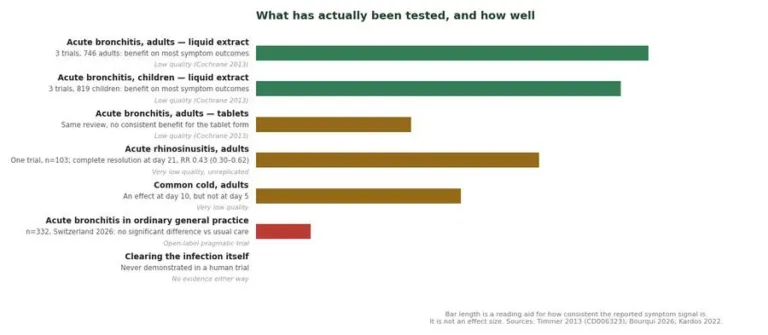
The reference point is the Cochrane review by Timmer and colleagues, first published in 2008 (PMID 18646148) and updated in 2013 (PMID 24146345). Of ten eligible double-blind randomised trials, eight were analysable. Three trials in 746 adults with acute bronchitis showed effectiveness on most outcomes for the liquid preparation but not for the tablets; three trials in 819 children showed the same pattern. One sinusitis trial in 103 adults found a significant effect on complete resolution at day 21 (risk ratio 0.43, 95% CI 0.30 to 0.62). One common-cold trial showed an effect at ten days but not at five. The review authors graded the evidence low quality for the bronchitis trials and very low quality for sinusitis and the common cold, noted that every trial was investigator-initiated, noted unvalidated outcome assessment, and recorded a suspicion of publication bias from the funnel plot (PMID 24146345). Evidence suggests
That is the honest headline: a consistent symptom signal in a body of evidence that Cochrane itself does not trust very far. An earlier independent meta-analysis reached a similar conclusion for acute bronchitis (PMID 18222667). Evidence suggests
The trials underneath
The individual studies are mostly German-sponsored, mostly conducted in eastern Europe, and mostly on the same extract: acute bronchitis in adults (PMID 12807337, PMID 16781588, PMID 17288687, PMID 18449849), a tablet dose-finding study (PMID 20387996), non-group-A streptococcal tonsillopharyngitis in children (PMID 14526713), and the common cold (PMID 31341433). Manufacturer-linked meta-analyses have pooled them for cough and quality of life (PMID 36051888), for recovery and paracetamol use in children (PMID 31014293), and for days off work (PMID 37476531). Evidence suggests An open-label study compared the extract with amoxicillin in uncomplicated acute bacterial rhinosinusitis (PMID 32456442). Evidence suggests A broader systematic review of complementary treatments for acute bronchitis in children found pelargonium the best-supported of them (PMID 32147041), and a 2026 systematic review of the species reaches a favourable overall verdict (PMID 41653615). Evidence suggests
The concentration of the evidence in one sponsor’s hands is not an accusation; it is a structural fact about herbal medicine, where nobody but the manufacturer has a commercial reason to fund a trial. It is also exactly why independent replication carries disproportionate weight here.
The two independent trials, and what they found
The HATRIC study in UK primary care was designed to test whether a clean independent trial could be run at all. Its protocol was published (PMID 31384480) and its results reported in 2021 (PMID 33514367). Of 543 patients screened, 261 were eligible and 134 were recruited; 77% returned a completed diary; adherence was good; there were no serious treatment-related adverse events. The feasibility answer was yes. The efficacy answer was not the point, and the trial was not powered to give one — though antibiotic use ran 48% on Kaloba liquid against 23% on liquid placebo, and 48% on Kaloba tablets against 50% on tablet placebo, a pattern that does not flatter the hypothesis and that a feasibility trial cannot interpret. Evidence suggests
Then, in April 2026, the Swiss PHYTOBRONCH trial reported (PMID 42014704). It was pragmatic and open-label, run across 36 primary care practices and five walk-in clinics, and it randomised 332 adults with acute bronchitis to the extract or to usual care. Neither co-primary outcome reached significance: no difference in days to a 50% reduction in symptom severity (adjusted coefficient 0.05, 95% CI −0.13 to 0.23), and antibiotic use 17.4% versus 25.2% (adjusted risk ratio 0.78, 95% CI 0.49 to 1.26). Adverse events were more frequent in the extract group, 32.3% versus 21.5% (hazard ratio 1.40, 95% CI 1.03 to 1.89), all of them mild and previously described. The authors’ own conclusion is that the extract did not reduce symptom duration or antibiotic use significantly, while noting that the direction of the antibiotic result deserves a larger trial (PMID 42014704). Confirmed
PHYTOBRONCH is not the end of the argument. It was open-label, which cuts both ways in a symptom trial, and it compared against usual care, with no placebo arm. But it is the largest independent, non-manufacturer test of the thing people actually buy it for, in the setting they actually buy it for, and it did not reproduce the effect. Anyone writing about this herb who does not mention it is writing from a 2013 reading list.
So where does that leave it
As with Syrian rue in No. 2 of this series, the useful question is not whether a plant “works” but what grade of evidence a particular claim rests on, and who generated it.
Our reading, stated plainly: there is real published evidence that a specific liquid root extract shortens and softens the symptoms of acute bronchitis, and the best independent assessment of that evidence calls it low quality. Evidence suggests There is no evidence that it treats the underlying infection. Confirmed The tablet form has never performed as well as the liquid in the same review. Evidence suggests And the most recent independent pragmatic trial found nothing. Confirmed “Evidence suggests” is the correct verb tense for this plant, and it has not moved to “confirmed”.
9. Safety, side effects and who should leave it alone
First, the illness
The largest safety question about a cough remedy is usually not the remedy. It is whether the illness being self-treated is the self-limiting one the buyer assumes it is. Acute bronchitis in an otherwise well adult settles on its own over one to three weeks, and the case for any symptomatic treatment is that it makes those weeks easier. A number of other conditions arrive at the counter looking identical, do not settle, and are made no better by something that improves the first few days. Confirmed
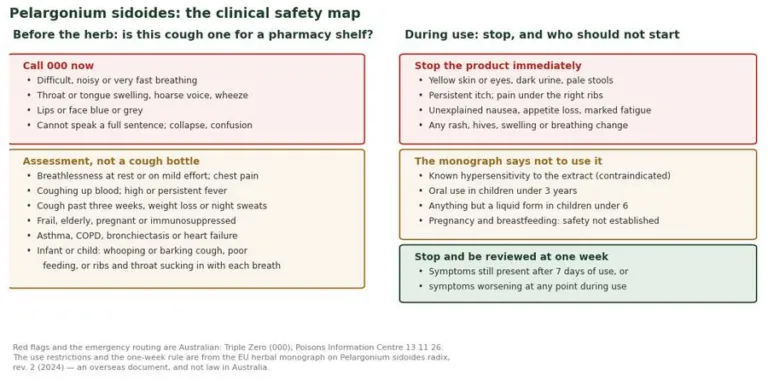
The features that put a chest illness outside what a pharmacy shelf can answer: breathlessness at rest or on mild exertion, fast or laboured breathing, chest pain, coughing up blood, a high or persistent fever, drowsiness or confusion, and a cough in anyone frail, elderly, pregnant, immunosuppressed, or living with asthma, COPD, bronchiectasis or heart failure. In an infant or young child, add a whooping, paroxysmal or barking cough, poor feeding, and breathing that sucks in at the ribs or at the base of the throat. A cough that has run past three weeks, or that comes with weight loss or drenching night sweats, is a different question again. None of those is a purchase; all of them are an assessment. Confirmed
If breathing is difficult or noisy, the lips or face look blue or grey, or the person cannot speak a full sentence, that is Triple Zero (000), immediately. Confirmed
The European monograph writes a time limit into its own instructions for precisely this reason: if symptoms are still present after a week of use, or worsen at any point during it, the product is stopped and the person is reviewed (EU herbal monograph, rev. 2). Confirmed That one-week rule is arguably the most clinically important line in the document, and it is the line least likely to reach a shelf-talker. There is a second reason to take a long cough seriously here, and it sits in this plant’s own history: the traditional indication that carried this root to Europe was tuberculosis. Traditional A cough of more than three weeks with weight loss or night sweats is a tuberculosis and malignancy question, answered by imaging and sputum through the public health system, and nothing on a pharmacy shelf substitutes for that. Confirmed
Start with the adverse-effects table from the current EU herbal monograph, because it is the most carefully assembled list in existence and every frequency in it is honest. Under undesirable effects, revision 2 of the monograph lists hypersensitivity including anaphylactic reaction; rash, pruritus, urticaria and angioedema; nasal bleeding; diarrhoea, epigastric pain, nausea, vomiting and gingival bleeding; and hepatotoxicity and hepatitis. Every one of them is recorded as frequency not known (EU herbal monograph, rev. 2). Confirmed That is a regulator saying, in the only language it has, that these things have been reported and nobody can tell you how often.
In the trials themselves, adverse events were predominantly mild gastrointestinal complaints, plausibly attributable to the tannins, plus a slightly higher rate of hypersensitivity reactions, gingival bleeding and epistaxis on extract than on placebo (EMA assessment report). Evidence suggests Across ten years of periodic safety update reports covering June 2013 to June 2023, 1,097 individual case safety reports were received; the benefit–risk assessment was left unchanged (EMA assessment report). Confirmed
The liver, and how the question was handled
This is the part that gets reported badly, in both directions. From 2004 German regulators received spontaneous reports of liver injury in people who had taken pelargonium preparations. Teschke and colleagues then did the thing that is supposed to be done and rarely is: they took the cases and scored them on the liver-specific CIOMS causality scale. In the first series of 15 cases, none reached probable or highly probable causality, and the analysis found extensive confounding and poor data quality — biliary imaging in only three patients, hepatitis A–C excluded in only four (PMID 22381150). Confirmed In a second series of 13 spontaneous cases, again none generated a positive safety signal, with alternative diagnoses including comedication injury, cholangitis, cholecystitis, viral and bacterial hepatitis and autoimmune hepatitis (PMID 22700632). Confirmed The same group has shown that alternative causes account for roughly half of all initially suspected herb-induced liver injury cases in the published series (PMID 23510966). Confirmed Their conclusions were contested in the same journal (PMID 22728685), which is how this is supposed to work.
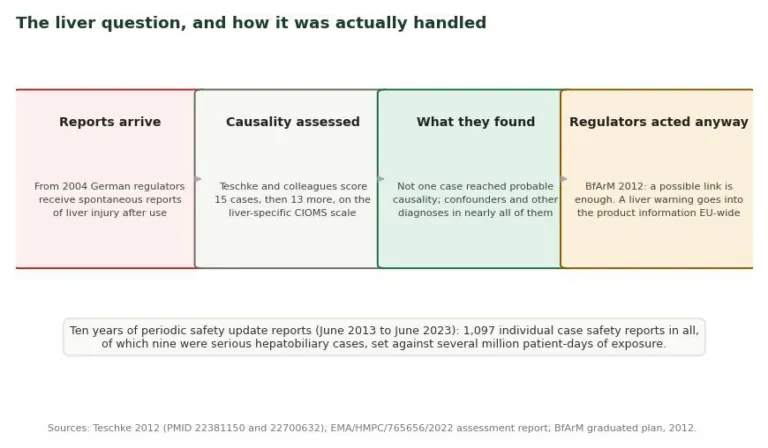
Against that, the Berlin Case-Control Surveillance Study — a prospective hospital-based study, not a spontaneous-report series — ascertained one case of liver injury in which Pelargonium sidoides was assessed as a possible cause, among 198 hepatotoxicity cases over nine years (PMID 26784183). Evidence suggests One possible case is a weak signal, and the authors said so.
The German regulator BfArM, reviewing 30 spontaneous hepatic reports to June 2012 (26 from Germany, two from Switzerland, one from Italy and one from Singapore), graded most of them a possible association and three of them probable, concluded there was at least a possible association overall, started a graduated plan and required a post-authorisation safety study; the liver warning went into the product information across the EU and is still in the monograph today (EMA assessment report). Confirmed Note the logic: a regulator does not need proof of causation to add a warning, and adding one is not a finding that the herb damages livers. Both statements in that sentence are true and people keep picking one.
More recent data are reassuring without being decisive. A randomised safety study in 591 children aged 1–5 found elevation of at least one liver enzyme in 4.1% at the end of treatment against 5.7% at baseline — that is, fewer afterwards than before — with all elevations below five times the upper limit of normal (PMID 36865690). Evidence suggests A post-authorisation safety study of 300 adults in the Philippines found no signs or symptoms of liver toxicity over seven days (PMID 41890334). Evidence suggests Neither study is large enough to exclude a rare idiosyncratic reaction, and neither claims to be.
Bleeding and anticoagulants
The structural argument in §6 is strong: pelargonium’s coumarins are not built like anticoagulants, and in animal work the extract neither acted as an anticoagulant nor altered warfarin’s effect or pharmacokinetics (EMA assessment report). Evidence suggests Coagulation parameters were measured in several of the bronchitis trials and did not shift (EMA assessment report). Evidence suggests The EU monograph records no interactions (EU herbal monograph, rev. 2). Confirmed
And yet nasal bleeding and gum bleeding are both on the adverse-effects list, at a slightly higher rate than placebo (EU herbal monograph, rev. 2, EMA assessment report). Confirmed Mucosal bleeding without a systemic coagulation effect is a plausible local phenomenon, and nothing warfarin-like, but “plausible” is the right word and not “established”. Mechanism Anyone on an anticoagulant, with a bleeding disorder, or heading for surgery has a real question to ask, and the trials excluded exactly those people — a “tendency to bleed” was an exclusion criterion in study after study (EMA assessment report). Confirmed The trial evidence does not cover them because it deliberately did not enrol them.
The monograph’s interactions entry deserves a closer read than it usually gets, because it is routinely misquoted as a safety finding. The monograph’s words under interactions are “none reported”, and that describes the state of the reporting, not the result of an investigation: the assessment report describes no human drug-interaction study of this extract at all. The assessment report’s own starting position is that, on chemical grounds, an enhancement of coumarin-type anticoagulants is theoretically possible, and that the question was answered in rats and never in people (EMA assessment report). Confirmed The same report notes elsewhere that rat and human coumarin metabolism diverge substantially — the rat runs a 3,4-epoxidation route that humans largely do not — which is a reason to hold animal reassurance about a coumarin-bearing extract loosely, and never to treat it as settled (EMA assessment report). Mechanism
Two further interaction questions are worth raising with a herbalist and not assuming away. A root extract required to carry at least 2% tannins is astringent enough that separating it by an hour or two from iron, or from any narrow-therapeutic-index medicine taken at the same time of day, is a cheap precaution; that is a general property of tannin-rich liquid preparations, with no documented effect of this one, and it is offered here as a mechanism, not a finding. Mechanism And in anyone already carrying liver disease, or taking a medicine with a recognised hepatic liability, the hepatic reports above are a reason for a considered decision and not a casual one, even though no individual case has reached probable causality. Confirmed
Who the monograph says should not take it
The contraindication in the EU monograph is hypersensitivity to the active substance (EU herbal monograph, rev. 2). Confirmed Beyond that, the monograph does not recommend oral use in children under three years; restricts liquid dosage forms only for children under six; and does not recommend use in pregnancy or lactation, because safety has not been established and no fertility data exist (EU herbal monograph, rev. 2). Confirmed The monograph sets its doses by age band and by preparation and specifies that a person whose symptoms last more than a week, or worsen, should be reviewed. We are reporting the structure of those rules, not prescribing them.
Those age rules are precautionary, with no observed harm behind them. They reflect the absence of data in the youngest children and a judgement that a cough in a child under three is something to have looked at, and not treated at home (EU herbal monograph, rev. 2). Confirmed It is worth noting against them that the largest paediatric safety study since — 591 children aged one to five — sits below that threshold and found no liver-enzyme signal (PMID 36865690). Evidence suggests The pregnancy and lactation entry is the same kind of statement: not a finding of harm, but no established safety and no fertility data (EU herbal monograph, rev. 2). Confirmed The assessment report behind it is blunter still — no relevant information about safety in pregnancy or lactation, and no information on reproductive and developmental toxicity (EMA assessment report). Confirmed Part of the reason is structural, and it is the same reason the bleeding question is open: pregnancy was an exclusion criterion in the trials, so the clinical literature could not have generated the data even in principle (EMA assessment report). Confirmed That is where most herbal medicines sit. It is a reason for caution in deciding, and no reason for alarm in someone who has already taken a dose.
Two practical points the source documents make and labels generally do not. The monograph’s hepatic instruction is to stop the product immediately if signs of liver injury appear (EU herbal monograph, rev. 2) Confirmed — an instruction only usable if the signs are named: yellowing of the skin or of the whites of the eyes, dark urine, pale stools, a persistent itch, pain under the right ribs, or unexplained nausea, loss of appetite and marked fatigue. And the monograph records that no case of overdose has ever been reported (EU herbal monograph, rev. 2), Confirmed which is a gap in the record and no reassurance about it; nobody can tell you what a large accidental dose does. The Australian liquid’s own ARTG summary notes a closure that is neither child-resistant nor fitted with a restricted-flow insert (ARTG 193170), Confirmed so the realistic paediatric hazard attached to this particular product is a small child reaching an unattended bottle. For any swallowed overdose, actual or suspected, the Poisons Information Centre is 13 11 26, 24 hours, Australia-wide.
Two further points of fact. Reports of allergic reaction to the ethanolic root extract collected by the Uppsala Monitoring Centre between 2002 and 2006 included 34 cases from Germany, of which 15 had the description and timing of a type I hypersensitivity reaction, and two needed treatment for circulatory failure or anaphylactic shock — in one, a positive skin-prick test confirmed the extract as the cause (EMA assessment report). Confirmed And liquid preparations contain ethanol, which the monograph requires to be labelled (EU herbal monograph, rev. 2); for someone avoiding alcohol, or with liver disease in the history, a non-alcoholic form is the sensible choice (EMA assessment report). Confirmed
Before taking any botanical drug, consult a degree-qualified herbalist with competencies and adequate training in pharmacognosy. A herbalist trained in pharmacognosy can read an extract specification, knows what an 11% ethanol liquid extract at 1:8–10 actually is, and knows which of your other medicines matter.
10. The Australian regulatory position
Australia treats this plant unusually well, and the record is worth knowing.
What is on the register
Searching the Australian Register of Therapeutic Goods on 20/09/2026, we identified four entries naming Pelargonium sidoides.
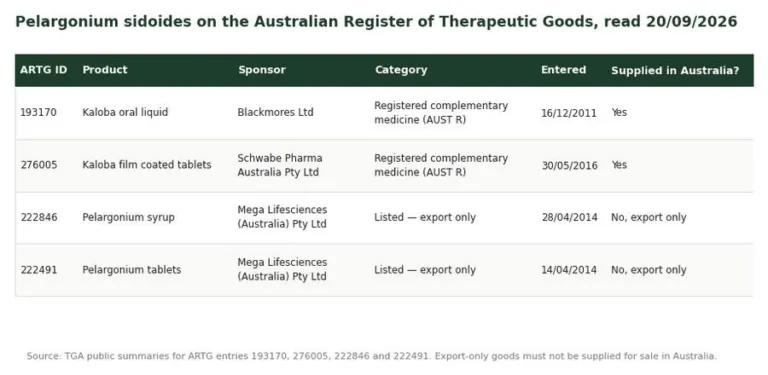
Kaloba oral liquid, ARTG 193170, sponsored by Blackmores Ltd, entered the register on 16/12/2011 as a registered complementary medicine. Its recorded specific indications are “for the treatment of acute bronchitis and acute sinusitis”. The active is Pelargonium sidoides root extract liquid at 800 mg/g, the excipients are glycerol and purified water, and the pack sizes are 20, 50 and 100 mL in a glass bottle. The poison-schedule field reads “Not scheduled. Not considered by committee” (ARTG 193170). Confirmed The record also notes the closure is neither child-resistant nor fitted with a restricted-flow insert — relevant in a house with small children.
Kaloba film coated tablets, ARTG 276005, sponsored by Schwabe Pharma Australia Pty Ltd, entered on 30/05/2016, also registered, indicated “for the relief of coughing associated with acute bronchitis”, 20 mg of root extract per tablet, also unscheduled (ARTG 276005). Confirmed Note that the tablet’s Australian indication is narrower than the liquid’s — which lines up neatly with the Cochrane finding that the tablets did not perform as the liquid did.
The other two entries are a trap for the unwary. Pelargonium syrup (ARTG 222846) and Pelargonium tablets (ARTG 222491), both sponsored by Mega Lifesciences (Australia) Pty Ltd, are listed export-only medicines. Their ARTG records carry the condition that the product “must not be supplied for sale in Australia, including supply via duty free outlets” (ARTG 222846, ARTG 222491). Confirmed Note the category carefully, because it is the distinction this whole chapter turns on: they are listed export-only entries, not registered ones, and being on the ARTG in that category is not approval for Australian supply. They sit on the Australian register because they are sponsored from Australia for overseas markets. The practical point for a reader is simply that an ARTG number on its own does not mean a product may lawfully be sold here — the entry has to be one that permits Australian supply. “Pelargonium syrup” and “Pelargonium tablets” are also generic descriptions and no distinctive brand names, so seeing those words on an Australian label does not by itself tell you which ARTG entry, if any, the product belongs to; the number on the pack does.
AUST R, and why it is unusual
Most herbal products in Australia are listed (AUST L): the sponsor self-certifies against a list of permitted ingredients and permitted indications, and the TGA does not assess efficacy before market. That is the pathway at the centre of the TGA’s current review of andrographis, No. 3 in this series. Both Kaloba products are registered (AUST R) complementary medicines, which means safety, quality and efficacy were evaluated before they went on sale. Confirmed That is a small club.
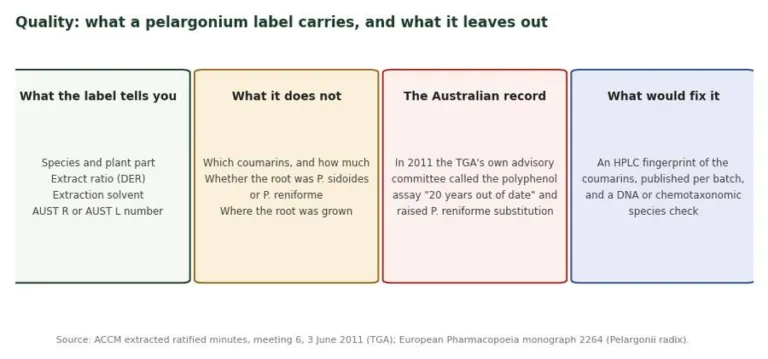
The evaluation is on the public record, and it is candid. The TGA’s Advisory Committee on Complementary Medicines considered the Kaloba application at its fifth meeting in March 2011 and returned to it at its sixth on 3 June 2011. The published minutes show the committee satisfied on safety, arguing about efficacy, and divided on quality (ACCM minutes, 03/06/2011). Attested On quality, some members — the minutes are careful to say some, not the committee — “remained unconvinced” that a universal non-specific assay for all polyphenolic compounds was adequate, “as this methodology is 20 years out of date and provides a crude measure of the total amount of polyphenols, not the changes occurring within the suite of coumarin compounds”, and observed that the coumarins could be measured by HPLC instead. A member also raised that the herbal material could be adulterated with the closely related Pelargonium reniforme and questioned how the method could distinguish the two, since both contain coumarins (ACCM minutes, 03/06/2011). Attested
The minutes record the answer as well, and it belongs here. A TGA officer replied that the assay, while a crude quantitative measure and “probably not suited for use as a definitive identification test”, was sensitive enough to detect a downward trend in polyphenol content and so was a valid measure of the stability of the extract, and that arbitrarily picking a marker compound might not give a more meaningful measure of ongoing quality. Members acknowledged the genuine difficulty of choosing a marker when the active constituents are not known. Their landing point was that the data showed efficacy and a good safety profile but “the demonstration of quality was not ideal”, and that “it would be unfortunate for the medicine to not be available in Australia based on this issue alone, given that herbal materials are complex substances and are not always well characterised” (ACCM minutes, 03/06/2011). Attested That is a real reservation about an analytical method, recorded and then weighed. It is not a finding that any product on sale is substandard, and nothing in the minutes says it is.
On efficacy the committee accepted a single rhinosinusitis trial supported by a plausible mechanism, consistent with the Australian Regulatory Guidelines for Complementary Medicines, while recording that the Cochrane review had said the result needed replication and more valid endpoints, and that the committee “concurred with this conclusion” (ACCM minutes, 03/06/2011). Attested Its final recommendation was that a sufficient level of evidence had been demonstrated — with the explicit rider that this rested on one study in rhinosinusitis and “should be reviewed if evidence changes” (ACCM minutes, 03/06/2011). Attested
Fifteen years later the evidence has changed. The Cochrane update graded it low quality (PMID 24146345), the EMA declined to move the root to well-established use and kept it at traditional use in 2024 (EU herbal monograph, rev. 2), and an independent pragmatic trial has now reported no significant benefit (PMID 42014704). Whether that meets the committee’s own trigger for review is a question for the TGA, not for us. We simply note that the committee wrote the trigger down.
Scheduling, import and advertising
Pelargonium sidoides is not a scheduled substance. The poison-schedule field on the TGA’s own public summary for each of the two Australian products reads “Not scheduled. Not considered by committee” (ARTG 193170, ARTG 276005) Confirmed — meaning the herb is absent from a schedule and has never been put to the scheduling delegate at all. It carries no prescription-only (Schedule 4), controlled-drug (Schedule 8), prohibited (Schedule 9 or 10) or Appendix C status. The instrument in force as we write is the Therapeutic Goods (Poisons Standard—June 2026) Instrument 2026 (Cth), F2026L00633, made on 27/05/2026 (Poisons Standard, June 2026). Confirmed Scheduling is amended several times a year, and the Poisons Standard only takes legal effect through state and territory drugs-and-poisons law — in Queensland, the Medicines and Poisons Act 2019 and its regulations — so anyone relying on scheduling status for a commercial or clinical decision should re-check the instrument then current and not this article.
Because it is not a controlled substance, the Office of Drug Control permit and licence system, which governs narcotic drugs and precursors under the Commonwealth customs import prohibitions, does not apply to it. What does apply to live plants, seed and other plant material is Commonwealth biosecurity, through the import conditions system (BICON import conditions), and to any finished therapeutic good, the TGA import requirements. Confirmed
Advertising is where a consumer is most likely to meet a problem. Anything said about a therapeutic good in Australia has to sit inside the Therapeutic Goods Advertising Code, and for these products the only indications on the register are the narrow ones quoted above (TGA advertising rules). Confirmed A website that tells you pelargonium “fights infection”, “boosts immunity” or helps with COVID-19 is making a claim the Australian register does not carry.
Why this article names products at all. Every statement above about a named product is taken from the TGA’s own public ARTG summary for that entry, read on 20/09/2026, or from a published clinical trial that used it. The ARTG is a public register and these four entries are the whole of the Australian picture for this plant, so a review that left them out would be useless to the reader it is written for. Naming them is description, not endorsement and not criticism: the Institute has no commercial relationship with, and receives nothing from, any sponsor, manufacturer or retailer named anywhere in this article, and nothing here is a recommendation to buy, avoid or take any of them. Where we report what a regulator, a committee or a trialist said, we say who said it and cite the document, and readers can check every one.
11. Quality, adulteration and where the root comes from
Three problems sit on top of each other here, and they are all consequences of the same fact: the medicine is a tuberous root.
Identity
Dried, fragmented root has no flowers, so the character that separates P. sidoides from P. reniforme in the field is gone by the time material reaches a factory. The Pharmacopoeia monograph accepts both species, so substitution is not fraud in the pharmacopoeial sense — but a buyer who thinks they are getting one species may be getting the other, and the two are not chemically identical (EMA assessment report). Confirmed Australia’s own advisory committee flagged exactly this in 2011, and the answer it received was that the polyphenol assay in use was “probably not suited for use as a definitive identification test” — adequate for tracking stability, not designed to tell two species apart (ACCM minutes, 03/06/2011). Attested Fifteen years on, HPLC methods for the coumarins exist and are published (PMID 36297296). There is no technical reason a certificate of analysis could not carry a coumarin fingerprint. Mechanism
Standardisation
A tannin limit of not less than 2.0% as pyrogallol (EMA assessment report) tells you the material is a tannin-rich root. It does not tell you the coumarin profile, and the coumarins are the part that is chemically diagnostic for the genus. Confirmed Between an extract defined by its drug-to-extract ratio and solvent, and one defined by a marker compound, the herb currently sits in the first category — which is defensible for a complex extract and still leaves batch-to-batch equivalence largely unproven.
Supply
Harvesting a tuber kills the plant. That single fact separates pelargonium from the bark and leaf trades, where a stand can be cropped and left standing. Lewu, Adebola and Afolayan documented the commercial harvest in the Eastern Cape and the balance it forces between conservation and rural income (Lewu et al. 2007). Evidence suggests The research effort that has gone into propagating the species — tissue culture and acclimatisation with the phenolic profile and activity of the parent material checked afterwards (PMID 23892203), agronomic work on irrigation and nitrogen and their effect on metabolite yield (PMID 32471248), and a 2024 review of cultivation practice (Mtimkulu et al. 2024) — exists because the wild supply cannot carry the demand. Evidence suggests Van Niekerk and Wynberg’s analysis of the trade addresses the other half: who in the chain actually captures the value (van Niekerk & Wynberg 2012). Attested
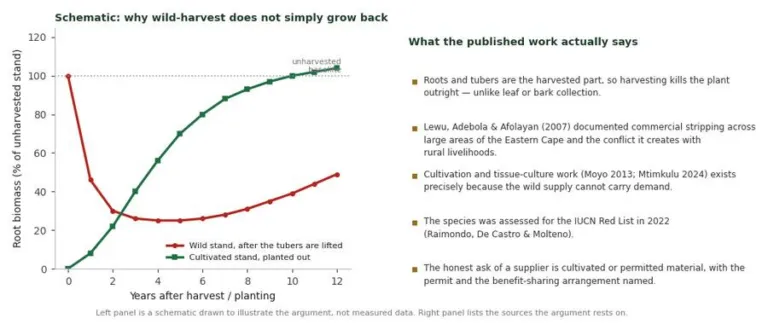
The honest ask of a supplier is short: is this root cultivated or wild-harvested, and if wild-harvested, under whose permit and with what benefit-sharing arrangement? A supplier who can answer that has done the work. A supplier who cannot is selling you a question mark.
12. What an Australian buyer can actually check
Not advice about whether to take it — that is a conversation to have with a qualified person. Just the things that are checkable standing at a shelf or reading a website.
- An AUST R or AUST L number, and which one. AUST R on a complementary medicine means efficacy was evaluated. On this plant in Australia, the two products for local supply are AUST R. Confirmed
- The species, in full. Pelargonium sidoides, not “African geranium” alone. If the label will not commit to a binomial, it has not committed to anything.
- The plant part. Root. The evidence base is root extract; leaf material is a different proposition with a different chemistry.
- The extract specification. A drug-to-extract ratio and an extraction solvent — for the liquid form that is 1:8–10 in about 11% ethanol (EU herbal monograph, rev. 2). An extract with no ratio and no solvent named is not comparable to anything in the literature. Confirmed
- Liquid or tablet. The Cochrane review found the liquid preparations performed and the tablets did not, in the same analysis (PMID 24146345). Australia’s own register reflects that: the liquid carries the broader indication. Evidence suggests
- The indication on the pack, against the claim on the website. The register says acute bronchitis and acute sinusitis for the liquid; coughing associated with acute bronchitis for the tablets. Anything broader than that is marketing (ARTG 193170, ARTG 276005). Confirmed
- Ethanol content, if that matters to you or to your liver history (EU herbal monograph, rev. 2). Confirmed
- Provenance. Cultivated or wild? Under what permit? It is a fair question and the answer tells you what kind of company you are dealing with.
- Not “Pelargonium syrup” or “Pelargonium tablets” from an Australian seller. Those ARTG entries are export-only and must not be supplied for sale here (ARTG 222846). Confirmed
And the referral, which is the same as it is for every botanical drug: consult a degree-qualified herbalist with competencies and adequate training in pharmacognosy before taking it, particularly if you take an anticoagulant, have a bleeding disorder, have liver disease in your history, are pregnant or breastfeeding, are buying it for a small child, or the cough has already run longer than a week.
13. Discussion: conclusions, hypotheses and research still required
What we think this article supports
That Pelargonium sidoides root extract, in the specific liquid form that has been tested, is associated with faster settling of acute bronchitis symptoms in adults and children, on evidence that the best independent assessment grades as low quality. Evidence suggests That the tablet form has not matched the liquid in the same analysis. Evidence suggests That nothing in the literature shows it clears an infection. Confirmed That the liver signal, tested case by case on the liver-specific CIOMS scale by independent assessors, did not reach probable causality in any of the 28 spontaneous cases examined, and that regulators nonetheless warn about it, correctly, because absence of proof is not proof of absence. Confirmed That the coumarins in this root are structurally incapable of warfarin-like anticoagulation, while mucosal bleeding remains on the adverse-effect list unexplained. Confirmed That Australia registered the product on an unusually thorough evaluation that recorded its own reservations about quality and told itself to look again if the evidence changed. Attested And that the evidence has changed. Confirmed
What is still hypothesis
That the difference between liquid and tablet is a real pharmaceutical effect — bioavailability, or something in the liquid matrix that the dry extract loses — and no artefact of which trials happened to be run. Mechanism That the nasal and gingival bleeding reflects a local mucosal effect of astringent proanthocyanidins, with no systemic coagulation change. Mechanism That the antiviral and barrier effects seen in cell culture contribute anything at concentrations a person actually achieves. Mechanism That the lower antibiotic use in PHYTOBRONCH — 17.4% against 25.2%, which the trial’s authors describe as a 31% relative reduction, and which did not reach significance on the adjusted analysis (risk ratio 0.78, 95% CI 0.49 to 1.26) — is a real antimicrobial-stewardship effect and not noise; those authors think it worth a larger study, and we agree. Evidence suggests None of these is a finding. They are the shape of the next decade of work.
What research would actually move this
Clinical. One adequately powered, independent, placebo-controlled trial of the liquid extract in adults with acute bronchitis, with antibiotic prescribing as a co-primary outcome and a validated symptom instrument, run outside the manufacturer’s sphere. HATRIC showed it can be recruited (PMID 33514367); PHYTOBRONCH showed what happens pragmatically (PMID 42014704); the blinded, powered version has still not been done. A head-to-head of liquid versus tablet in the same trial would settle the formulation question in one stroke.
Phytochemistry and quality analysis. A published, inter-laboratory-validated HPLC or LC-MS fingerprint for the pelargonium coumarins, reported per batch, with a defined criterion that separates P. sidoides from P. reniforme material. The analytical chemistry exists (PMID 36297296); what does not exist is the agreement to use it as a release specification. A parallel DNA-barcoding check on commercial dried root would tell us, for the first time, what is actually in the Australian supply chain.
Pharmacology. Pharmacokinetics. We know very little about what happens to the coumarins and proanthocyanidins of this extract in a human being — absorption, metabolism, what concentration any of the in-vitro actives reaches in airway tissue. Without that, every mechanistic claim in §7 stays a mechanism and never becomes an explanation.
Toxicology and pharmacovigilance. A prospective cohort with scheduled liver-function testing, large enough to put a number on an idiosyncratic hepatic event rate, instead of another round of retrospective causality scoring. And a specific study of mucosal bleeding — platelet function and local mucosal effects — in people taking the liquid extract, including the anticoagulated patients every trial has excluded.
Botany and conservation. Published, peer-reviewed measurement of what actually happens to a wild P. sidoides stand after commercial tuber harvest, at ten and twenty years, across the Eastern Cape and Lesotho. The schematic in §11 is a schematic because that dataset is thin, and the species deserves a real one. Alongside it, an honest cost comparison of cultivated versus wild-harvested root that includes the benefit-sharing payment instead of treating it as an externality.
Regulatory science and ethics. Two questions worth an Australian paper. First: what should trigger a formal re-review of a registered complementary medicine when the evidence base moves, and did this one trigger it? The ACCM wrote the condition into its own recommendation in 2011 (ACCM minutes, 03/06/2011); nobody has tested what happens when it is met. Second: what would meaningful access and benefit-sharing disclosure on an Australian therapeutic-goods label look like, given the obligations Australia has accepted under the Nagoya Protocol and the origin of products like this one? At present a consumer in Cardwell can find out the glycerol content of a bottle of Kaloba and nothing whatever about the people whose knowledge is in it.
The short answer to the question people are actually asking
Coming off one cold-and-flu herb — andrographis, for most Australians this winter — and looking for the next one is the wrong move, and it is the move the internet is currently recommending. Pelargonium is not a better andrographis. It is a different plant with a different risk profile, a real but fragile evidence base, and a single recent independent trial that found nothing. It is one of the more honestly documented botanicals on an Australian shelf, and that documentation says: modest, uncertain, symptomatic. Anyone who tells you more than that has not read the Cochrane review, or has read it and decided not to mention the grade.
About the Australian Institute of Pharmacognosy and this series
The Australian Institute of Pharmacognosy is a clinic and research laboratory in Cardwell, far north Queensland, studying medicinal plants and natural products to the same evidentiary standard as any other branch of pharmacology: traditional knowledge taken seriously, and tested honestly. Visit the Institute at australian-pharmacognosy.org.
Series: AIP Monographs. Previous: No. 3, andrographis (Andrographis paniculata) · No. 2, Syrian rue (Peganum harmala) · No. 1, rosary pea (Abrus precatorius). Follow the series for a new evidence-graded monograph each morning.
Corrections: if you find an error or a source we have missed, write to the Institute at our contact form. We would rather correct a claim than repeat it.
Head of Education and Research
Australian Institute of Pharmacognosy
Cardwell QLD, Australia
australian-pharmacognosy.org · our contact form
Suggested citation: Ridley T. Umckaloabo (Pelargonium sidoides DC.): an evidence-graded monograph on the root extract, its clinical evidence, its safety record and its Australian regulatory status. AIP Monograph No. 4. Cardwell (QLD): Australian Institute of Pharmacognosy; 2026.
Educational content only; not medical, legal or regulatory advice. Australian regulatory information reflects the ARTG, the Poisons Standard and TGA publications as read on 20/09/2026 and may change. European documents are cited as overseas material and do not apply in Australia. Products, sponsors and companies are named only because they appear on a public register or in a published study, and every statement about them is drawn from that record; naming is neither endorsement nor criticism, and the Australian Institute of Pharmacognosy has no commercial relationship with, and receives nothing from, any of them. Nothing in this article is a recommendation to buy, avoid, supply or take any named product.
References
54 references: tap to open
Listed in order of first citation. All 34 PMIDs were verified against PubMed on 20/09/2026; every regulatory, patent and botanical record was read the same day.
- Therapeutic Goods Administration. Public summary, ARTG entry 193170: Kaloba oral liquid (sponsor Blackmores Ltd; registered complementary medicine; ARTG start date 16/12/2011). Read 20/09/2026. https://www.tga.gov.au/resources/artg/193170
- European Medicines Agency, Committee on Herbal Medicinal Products. European Union herbal monograph on Pelargonium sidoides DC; Pelargonium reniforme Curt., radix — Final, Revision 2. EMA/HMPC/648100/2022. Adopted 29 May 2024. (European instrument; it does not apply in Australia.) https://www.ema.europa.eu/en/documents/herbal-monograph/final-european-union-herbal-monograph-pelargonium-sidoides-dc-pelargonium-reniforme-curt-radix-revision-2_en.pdf
- South African National Biodiversity Institute. Pelargonium sidoides DC. PlantZAfrica species profile. Accessed 20/09/2026. https://pza.sanbi.org/pelargonium-sidoides
- Brendler T, van Wyk BE. A historical, scientific and commercial perspective on the medicinal use of Pelargonium sidoides (Geraniaceae). J Ethnopharmacol. 2008 Oct 28;119(3):420-33. PMID 18725280. DOI 10.1016/j.jep.2008.07.037.
- European Medicines Agency, Committee on Herbal Medicinal Products. Assessment report on Pelargonium sidoides DC; Pelargonium reniforme Curt., radix. EMA/HMPC/765656/2022, Revision 2. (European document; overseas, and not Australian law.) https://www.ema.europa.eu/en/documents/herbal-report/final-assessment-report-pelargonium-sidoides-dc-pelargonium-reniforme-curt-radix-revision-2_en.pdf
- Raimondo D, De Castro A, Molteno S. Pelargonium sidoides. The IUCN Red List of Threatened Species, published 27 September 2022. https://doi.org/10.2305/IUCN.UK.2022-2.RLTS.T219273119A219273122.en
- Atlas of Living Australia. Occurrence record searches for Pelargonium sidoides, Pelargonium australe and the genus Pelargonium in Australia, run via the ALA occurrence web service on 20/09/2026. https://biocache.ala.org.au/occurrences/search?q=genus%3APelargonium&fq=country%3AAustralia
- Business Queensland. Prohibited invasive plants and restricted invasive plants under the Biosecurity Act 2014 (Qld). Accessed 20/09/2026. Pelargonium sidoides does not appear on either list. https://www.business.qld.gov.au/industries/farms-fishing-forestry/agriculture/biosecurity/plants/invasive/restricted
- Department of Agriculture, Fisheries and Forestry (Cth). BICON — the Australian Biosecurity Import Conditions system. Accessed 20/09/2026. https://bicon.agriculture.gov.au/
- European patent EP1429795B1, “Method for producing extracts of pelargonium sidoides and/or pelargonium reniforme”, applicant Dr Willmar Schwabe GmbH & Co. KG. Public patent record: four oppositions, by Frutarom Schweiz AG and the African Centre for Biosafety et al. (both effective 10/03/2008), Alpinamed AG (11/03/2008) and Finzelberg GmbH & Co. KG (13/03/2008); legal status Revoked, revocation effective 26/01/2010. Read 20/09/2026 from the EPO register data as republished by Google Patents, which carries its own disclaimer that the legal-status field is not a legal conclusion; the authoritative source is the EPO European Patent Register. https://patents.google.com/patent/EP1429795B1/en
- Msomi Z, Matthews S. Protecting indigenous knowledge using intellectual property rights law: the Masakhane Pelargonium case. Africanus: Journal of Development Studies. 2016;45(1):62–77. DOI 10.25159/0304-615X/645. https://doi.org/10.25159/0304-615X/645
- van Niekerk J, Wynberg R. The trade in Pelargonium sidoides: rural livelihood relief or bounty for the “bio-buccaneers”? Development Southern Africa. 2012;29(4):530–547. DOI 10.1080/0376835X.2012.715440. https://doi.org/10.1080/0376835X.2012.715440
- Alossaimi MA, Alzeer MA, Abdel Bar FM, ElNaggar MH. Pelargonium sidoides Root Extract: Simultaneous HPLC Separation, Determination, and Validation of Selected Biomolecules and Evaluation of SARS-CoV-2 Inhibitory Activity. Pharmaceuticals (Basel). 2022 Sep 23;15(10):1184. PMID 36297296. DOI 10.3390/ph15101184.
- Honchar O, Мykhailenko O, Holovchenko O, Georgiyants V. Pelargonium sidoides – from ethnopharmacology to evidence-based medicine: a systematic review. Phytomedicine. 2026 Apr;153:157880. PMID 41653615. DOI 10.1016/j.phymed.2026.157880.
- Cinatl J, Wass MN, Michaelis M. Multiple mechanisms enable broad-spectrum activity of the Pelargonium sidoides root extract EPs 7630 against acute respiratory tract infections. Front Pharmacol. 2024;15:1455870. PMID 39469622. DOI 10.3389/fphar.2024.1455870.
- Trun W, Kiderlen AF, Kolodziej H. Nitric oxide synthase and cytokines gene expression analyses in Leishmania-infected RAW 264.7 cells treated with an extract of Pelargonium sidoides (Eps 7630). Phytomedicine. 2006 Sep;13(8):570-5. PMID 16920512. DOI 10.1016/j.phymed.2005.07.004.
- Emanuel J, Papies J, Galander C, Adler JM, Heinemann N, Eschke K, et al. In vitro and in vivo effects of Pelargonium sidoides DC. root extract EPs® 7630 and selected constituents against SARS-CoV-2 B.1, Delta AY.4/AY.117 and Omicron BA.2. Front Pharmacol. 2023;14:1214351. PMID 37564181. DOI 10.3389/fphar.2023.1214351.
- Perić A, Vezmar Kovačević S, Barać A, Perić A, Vojvodić D. Immunomodulatory Effects of Pelargonium sidoides Extract (EPs7630) in the Treatment of Acute Rhinosinusitis. Expert Rev Mol Med. 2025 Jul 15;27:e25. PMID 40660733. DOI 10.1017/erm.2025.10013.
- Timmer A, Günther J, Rücker G, Motschall E, Antes G, Kern WV. Pelargonium sidoides extract for acute respiratory tract infections. Cochrane Database Syst Rev. 2008 Jul 16(3):CD006323. PMID 18646148. DOI 10.1002/14651858.CD006323.pub2.
- Timmer A, Günther J, Motschall E, Rücker G, Antes G, Kern WV. Pelargonium sidoides extract for treating acute respiratory tract infections. Cochrane Database Syst Rev. 2013 Oct 22;2013(10):CD006323. PMID 24146345. DOI 10.1002/14651858.CD006323.pub3.
- Agbabiaka TB, Guo R, Ernst E. Pelargonium sidoides for acute bronchitis: a systematic review and meta-analysis. Phytomedicine. 2008 May;15(5):378-85. PMID 18222667. DOI 10.1016/j.phymed.2007.11.023.
- Matthys H, Eisebitt R, Seith B, Heger M. Efficacy and safety of an extract of Pelargonium sidoides (EPs 7630) in adults with acute bronchitis. A randomised, double-blind, placebo-controlled trial. Phytomedicine. 2003;10 Suppl 4:7-17. PMID 12807337. DOI 10.1078/1433-187x-00308.
- Chuchalin AG, Berman B, Lehmacher W. Treatment of acute bronchitis in adults with a pelargonium sidoides preparation (EPs 7630): a randomized, double-blind, placebo-controlled trial. Explore (NY). 2005 Nov;1(6):437-45. PMID 16781588. DOI 10.1016/j.explore.2005.08.009.
- Matthys H, Heger M. Treatment of acute bronchitis with a liquid herbal drug preparation from Pelargonium sidoides (EPs 7630): a randomised, double-blind, placebo-controlled, multicentre study. Curr Med Res Opin. 2007 Feb;23(2):323-31. PMID 17288687. DOI 10.1185/030079906X167318.
- Matthys H, Funk P. EPs 7630 improves acute bronchitic symptoms and shortens time to remission. Results of a randomised, double-blind, placebo-controlled, multicentre trial. Planta Med. 2008 May;74(6):686-92. PMID 18449849. DOI 10.1055/s-2008-1074519.
- Matthys H, Lizogub VG, Malek FA, Kieser M. Efficacy and tolerability of EPs 7630 tablets in patients with acute bronchitis: a randomised, double-blind, placebo-controlled dose-finding study with a herbal drug preparation from Pelargonium sidoides. Curr Med Res Opin. 2010 Jun;26(6):1413-22. PMID 20387996. DOI 10.1185/03007991003798463.
- Bereznoy VV, Riley DS, Wassmer G, Heger M. Efficacy of extract of Pelargonium sidoides in children with acute non-group A beta-hemolytic streptococcus tonsillopharyngitis: a randomized, double-blind, placebo-controlled trial. Altern Ther Health Med. 2003;9(5):68-79. PMID 14526713.
- Riley DS, Lizogub VG, Heger M, Funk P, Mueller H, Lehmacher W. Treatment with EPs 7630, a Pelargonium Sidoides Root Extract, Is Effective and Safe in Patients with the Common Cold: Results From a Randomized, Double Blind, Placebo-Controlled Clinical Trial. Integr Med (Encinitas). 2019 Feb;18(1):42-51. PMID 31341433.
- Kardos P, Lehmacher W, Zimmermann A, Brandes-Schramm J, Funk P, Matthys H, et al. Effects of Pelargonium sidoides extract EPs 7630 on acute cough and quality of life – a meta-analysis of randomized, placebo-controlled trials. Multidiscip Respir Med. 2022 Jan 12;17:868. PMID 36051888. DOI 10.4081/mrm.2022.868.
- Seifert G, Brandes-Schramm J, Zimmermann A, Lehmacher W, Kamin W. Faster recovery and reduced paracetamol use – a meta-analysis of EPs 7630 in children with acute respiratory tract infections. BMC Pediatr. 2019 Apr 23;19(1):119. PMID 31014293. DOI 10.1186/s12887-019-1473-z.
- Matthys H, Funk P, Zimmermann A, Lehmacher W. Effects of EPs 7630 on the duration of inability to work in acute bronchitis – a meta-analysis. Multidiscip Respir Med. 2023 Jan 17;18(1):914. PMID 37476531. DOI 10.4081/mrm.2023.914.
- Perić A, Gaćeša D, Barać A, Sotirović J, Perić AV. Herbal Drug EPs 7630 versus Amoxicillin in Patients with Uncomplicated Acute Bacterial Rhinosinusitis: A Randomized, Open-Label Study. Ann Otol Rhinol Laryngol. 2020 Oct;129(10):969-976. PMID 32456442. DOI 10.1177/0003489420918266.
- Wopker PM, Schwermer M, Sommer S, Längler A, Fetz K, Ostermann T, et al. Complementary and alternative medicine in the treatment of acute bronchitis in children: A systematic review. Complement Ther Med. 2020 Mar;49:102217. PMID 32147041. DOI 10.1016/j.ctim.2019.102217.
- Whitehead A, Simpson C, Willcox M, Webley F, Hay AD, Butler C, et al. HATRIC: a study of Pelargonium sidoides root extract EPs®7630 (Kaloba®) for the treatment of acute cough due to lower respiratory tract infection in adults-study protocol for a double blind, placebo-controlled randomised feasibility trial. Pilot Feasibility Stud. 2019;5:98. PMID 31384480. DOI 10.1186/s40814-019-0478-6.
- Willcox M, Simpson C, Wilding S, Stuart B, Soilemezi D, Whitehead A, et al. Pelargonium sidoides root extract for the treatment of acute cough due to lower respiratory tract infection in adults: a feasibility double-blind, placebo-controlled randomised trial. BMC Complement Med Ther. 2021 Jan 29;21(1):48. PMID 33514367. DOI 10.1186/s12906-021-03206-4.
- Bourqui A, Corpataux O, Bonofiglio F, Dubois J, Abolhassani N, Baggio S, et al. Pelargonium sidoides extract (EPs® 7630) versus usual care for acute bronchitis in Swiss primary care (PHYTOBRONCH): a pragmatic, open-label, randomised controlled trial. NPJ Prim Care Respir Med. 2026 Apr 21;36(1):41. PMID 42014704. DOI 10.1038/s41533-026-00499-1.
- Teschke R, Frenzel C, Schulze J, Eickhoff A. Spontaneous reports of primarily suspected herbal hepatotoxicity by Pelargonium sidoides: was causality adequately ascertained?. Regul Toxicol Pharmacol. 2012 Jun;63(1):1-9. PMID 22381150. DOI 10.1016/j.yrtph.2012.02.009.
- Teschke R, Frenzel C, Wolff A, Herzog J, Glass X, Schulze J, et al. Initially purported hepatotoxicity by Pelargonium sidoides: the dilemma of pharmacovigilance and proposals for improvement. Ann Hepatol. 2012;11(4):500-12. PMID 22700632.
- Teschke R, Schulze J, Schwarzenboeck A, Eickhoff A, Frenzel C. Herbal hepatotoxicity: suspected cases assessed for alternative causes. Eur J Gastroenterol Hepatol. 2013 Sep;25(9):1093-8. PMID 23510966. DOI 10.1097/MEG.0b013e3283603e89.
- Stammschulte T, Gundert-Remy U. Spontaneous reports of primarily suspected herbal hepatotoxicity by Pelargonium sidoides: Was causality adequately ascertained?. Regul Toxicol Pharmacol. 2012 Nov;64(2):342; author reply 343-4. PMID 22728685. DOI 10.1016/j.yrtph.2012.06.011.
- Douros A, Bronder E, Andersohn F, Klimpel A, Kreutz R, Garbe E, et al. Herb-Induced Liver Injury in the Berlin Case-Control Surveillance Study. Int J Mol Sci. 2016 Jan 15;17(1):114. PMID 26784183. DOI 10.3390/ijms17010114.
- Kamin W, Behre U, Helm K, Reling B, Funk P, Malek FA. Safety of Pelargonium extract EPs 7630 in young children with acute bronchitis. Front Pediatr. 2023;11:1107984. PMID 36865690. DOI 10.3389/fped.2023.1107984.
- Alvero RGY, Balmadrid AS, Aquino RCC, Balaccua GP. Short-term Liver Safety of Pelargonium sidoides DC. Root (PELARGO) 20 mg Capsule: A Non-interventional Post-authorization Safety Study. Acta Med Philipp. 2026;60(4):15-23. PMID 41890334. DOI 10.47895/amp.vi0.12322.
- Therapeutic Goods Administration. Public summary, ARTG entry 276005: Kaloba film coated tablets (sponsor Schwabe Pharma Australia Pty Ltd; registered complementary medicine; ARTG start date 30/05/2016). Read 20/09/2026. https://www.tga.gov.au/resources/artg/276005
- Therapeutic Goods Administration. Public summary, ARTG entry 222846: Pelargonium syrup (sponsor Mega Lifesciences (Australia) Pty Ltd; listed, export only; ARTG start date 28/04/2014). Read 20/09/2026. https://www.tga.gov.au/resources/artg/222846
- Therapeutic Goods Administration. Public summary, ARTG entry 222491: Pelargonium tablets (sponsor Mega Lifesciences (Australia) Pty Ltd; listed, export only; ARTG start date 14/04/2014). Read 20/09/2026. https://www.tga.gov.au/resources/artg/222491
- Therapeutic Goods Administration. Advisory Committee on Complementary Medicines (ACCM): extracted ratified minutes, meeting 6, 3 June 2011. Item 7.1, registration application for a product containing Pelargonium sidoides; recommendation 6.2. https://www.tga.gov.au/resources/publication/meeting-statements/accm-extracted-ratified-minutes-meeting-6-3-june-2011
- Therapeutic Goods (Poisons Standard—June 2026) Instrument 2026 (Cth), F2026L00633, made 27/05/2026; register status checked as in force on 20/09/2026. Pelargonium sidoides is not a scheduled substance: the TGA’s own ARTG public summaries for entries 193170 and 276005 record the poison schedule as “Not scheduled. Not considered by committee”. Scheduling is amended several times a year and takes legal effect through state and territory law. https://www.legislation.gov.au/F2026L00633/asmade
- Therapeutic Goods Administration. Advertising therapeutic goods: the Therapeutic Goods Advertising Code and what may lawfully be claimed. Accessed 20/09/2026. https://www.tga.gov.au/products/regulations-all-products/advertising
- Lewu FB, Adebola PO, Afolayan AJ. Commercial harvesting of Pelargonium sidoides in the Eastern Cape, South Africa: striking a balance between resource conservation and rural livelihood. Journal of Arid Environments. 2007;70(2):380–388. DOI 10.1016/j.jaridenv.2006.12.022. https://doi.org/10.1016/j.jaridenv.2006.12.022
- Moyo M, Aremu AO, Gruz J, Subrtová M, Szüčová L, Doležal K, et al. Conservation strategy for Pelargonium sidoides DC: phenolic profile and pharmacological activity of acclimatized plants derived from tissue culture. J Ethnopharmacol. 2013 Sep 16;149(2):557-61. PMID 23892203. DOI 10.1016/j.jep.2013.07.021.
- Mofokeng MM, Prinsloo G, Araya HT, du Plooy CP, Sathekge NR, Amoo SO, et al. Yield and Metabolite Production of Pelargonium sidoides DC. in Response to Irrigation and Nitrogen Management. Metabolites. 2020 May 27;10(6):219. PMID 32471248. DOI 10.3390/metabo10060219.
- Mtimkulu Y, Lewu MN, Mulidzi AR, Lewu FB. Cultivation and beneficial uses of Pelargonium sidoides DC. — a review. Journal of Medicinal Plants for Economic Development. 2024;8(1). DOI 10.4102/jomped.v8i1.246. https://doi.org/10.4102/jomped.v8i1.246
- Chemical records and structure depictions: PubChem, US National Library of Medicine. CIDs cited in the text: 5316862, 5280460, 5273569, 370, 7428, 9064, 65084, 54682930, 54678486. Public domain.
Image credits
- Pelargonium sidoides 1DS-II 2-0714.jpg, SAplants. CC BY-SA 4.0. Resized for the web by AIP; no other changes.
- Pelargonium sidoides 1DS-II 2-0715.jpg, SAplants. CC BY-SA 4.0. Resized for the web by AIP; no other changes.
- Pelargonium sidoides kz02.jpg, Krzysztof Ziarnek, Kenraiz. CC BY-SA 4.0. Resized for the web by AIP; no other changes.
- Pelargonium sidoides kz01.jpg, Krzysztof Ziarnek, Kenraiz. CC BY-SA 4.0. Resized for the web by AIP; no other changes.
- Pelargonium sidoides kz03.jpg, Krzysztof Ziarnek, Kenraiz. CC BY-SA 4.0. Resized for the web by AIP; no other changes.
- Pelargonium sidoides kz04.jpg, Krzysztof Ziarnek, Kenraiz. CC BY-SA 4.0. Resized for the web by AIP; no other changes.
- Pelargonium sidoides Leaves 3264px.jpg, Photo by and (c)2006 Derek Ramsey (Ram-Man). Location credit to the Chanticleer Garden.. CC BY-SA 3.0. Resized for the web by AIP; no other changes.
- Pelargonium sidoides (DITSL).JPG, James Steakley. CC BY-SA 3.0. Resized for the web by AIP; no other changes.
- 天竺葵屬 Pelargonium sidoides -牛津大學植物園 Oxford Botanic Garden- (9207603628).jpg, 阿橋 HQ. CC BY-SA 2.0. Resized for the web by AIP; no other changes.
- Medicinal Plants – US Botanic Gardens 28.jpg, Bohemian Baltimore. CC BY-SA 4.0. Resized for the web by AIP; no other changes.
- Pelargonium sidoides 05.jpg, Michael Wolf. CC BY-SA 3.0. Resized for the web by AIP; no other changes.
- Pelargonium sidoides 3zz.jpg, Photo by David J. Stang. CC BY-SA 4.0. Resized for the web by AIP; no other changes.
- Pelargonium reniforme 01.jpg, Krzysztof Ziarnek, Kenraiz. CC BY-SA 4.0. Resized for the web by AIP; no other changes.
- Pelargonium reniforme, c, Walter Sisulu NBT.jpg, JMK. CC BY-SA 3.0. Resized for the web by AIP; no other changes.
- Tyhume valley.JPG, Lysippos. CC BY-SA 3.0. Resized for the web by AIP; no other changes.
- Former ciskei settlement, eastern cape.jpg, Lysippos. CC BY-SA 3.0. Resized for the web by AIP; no other changes.
- Xhosa settlement in eastern cape – rsa.jpg, Lysippos. CC BY-SA 3.0. Resized for the web by AIP; no other changes.
- Amathole mountain, hogsback escarpment.jpg, Lysippos. CC BY-SA 3.0. Resized for the web by AIP; no other changes.
- Universiteit van Fort Hare ingang.jpg, Morné van Rooyen. free Attribution licence (any use, credit required). Resized for the web by AIP; no other changes.
- Maloti Mountains Village.jpg, SkyPixels. CC BY-SA 4.0. Resized for the web by AIP; no other changes.
- Cardwell Victoria Street 1.jpg, Torbenbrinker. CC BY-SA 4.0. Resized for the web by AIP; no other changes.
- Alice, Oos-Kaap.jpg, Morné van Rooyen. free Attribution licence (any use, credit required). Resized for the web by AIP; no other changes.
- Chemical structure depictions: PubChem, US National Library of Medicine (CIDs as captioned). Public domain.
- Charts and diagrams (timeline, trial map, hepatic assessment, ARTG table, quality panel, supply chart, patent chronology): Australian Institute of Pharmacognosy, 2026, CC BY 4.0, drawn from the sources cited in each caption.